Rabbi Joshua Bender
“דברה תורה כלשון בני אדם”
ברכות לא״ב
“The Torah speaks in human language”
Babylonian Talmud, Berakhot 31b
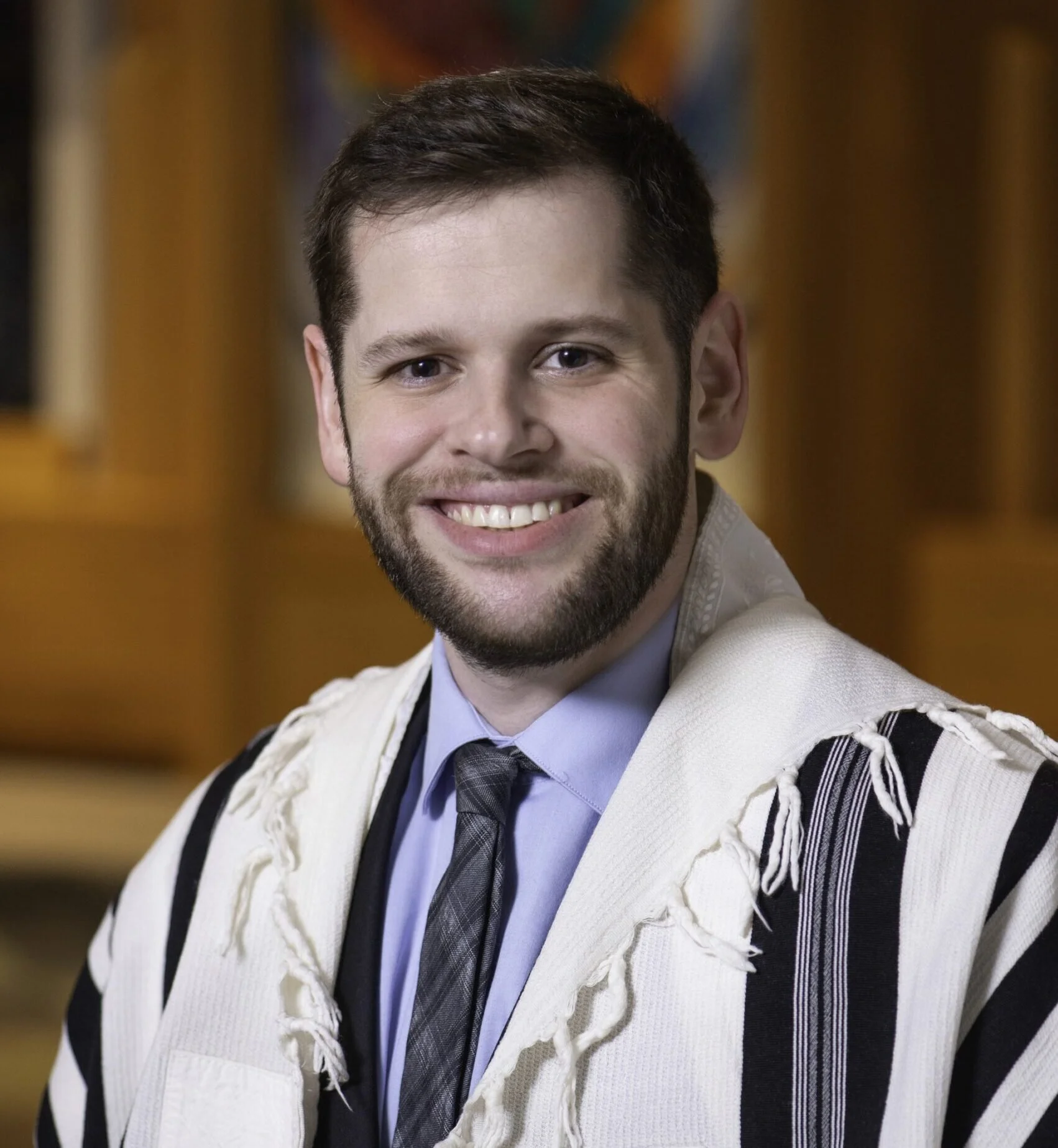
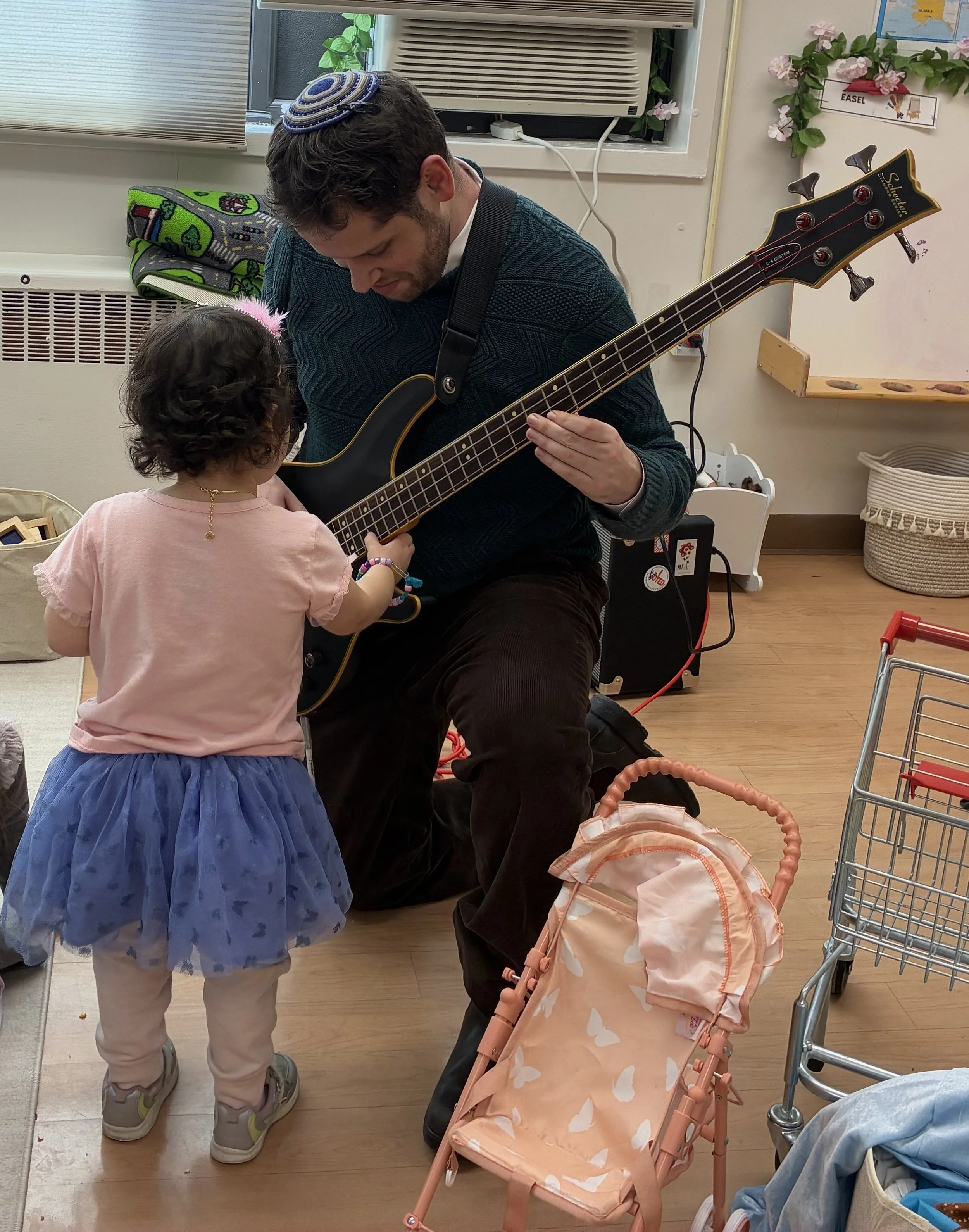
Torah and Jewish community have the ability to provide structure, meaning and beauty to every area of our lives. The job of a community rabbi is to work in partnership with their community to realize that vision. I believe the photo on the left represents that approach. As part of my current role, I occasionally visit our synagogue’s preschool to lead the kids in Torah-based musical and story activities. On this particular visit, I brought my bass guitar and a story I had written, inspired by a teaching from Rebbe Nachman of Breslov. I worked my bass guitar into the story and invited the kids to strum along with me.
I consistently try to bring learners of all ages up close and personal with Jewish rituals and ritual objects. I have organized and taught learning sessions related to our Sifrei Torah and mikveh. After services, I often invite children to look at the Sefer Torah with me. I want to make the grandeur and beauty of Judaism accessible to my community. I want them to see themselves as a small but essential part of Judaism and the Jewish People.
In my divrei Torah and teaching, I try to pick topics that I believe are new to my audience, and sources speaking from perspectives they may be unfamiliar with. That requires continually seeking out texts and perspectives that are new to me as well. Our spiritual lives are a canvas. I want to add as much texture and variety as I can to my own spiritual life and to the spiritual lives of those I serve.
Whether through my cooking, speaking, teaching, pastoral care or community organizing, I try to create intimacy and warmth. I want to build a sense of connection between the people I serve and the faith tradition that inspires us. I invite you to listen, read and see how I do so below.
My Philosophy
Divrei Torah & Public Speaking
MLK Weekend Sermon at Bethel Baptist Church - Rescheduled to 2/22/26
Through my interfaith work in the community, I became friends with the pastor of Bethel Baptist Church, Rev. Dr. Edward O. Williamson. Bethel is a historically African American faith community in White Plains. I invited Rev. Williamson to speak at our synagogue on the Shabbat of MLK weekend. In turn, he invited me to speak at his church that Sunday. A snowstorm forced us to reschedule, and I spoke to Rev. Williamson’s community the following month.
Remarks to White Plains Common Council - 2/3/2025
In 2023, a mall in downtown White Plains was demolished with the intention of redeveloping it into a mixed-use space containing a large number of new housing units. A grassroots campaign was launched to set aside a greater number of these units as affordable housing than was initially planned. One of the campaign’s organizers asked me to speak to the city leadership at a Common Council meeting.
Divrei Torah - Audio Only
Life-Cycle & Community Building
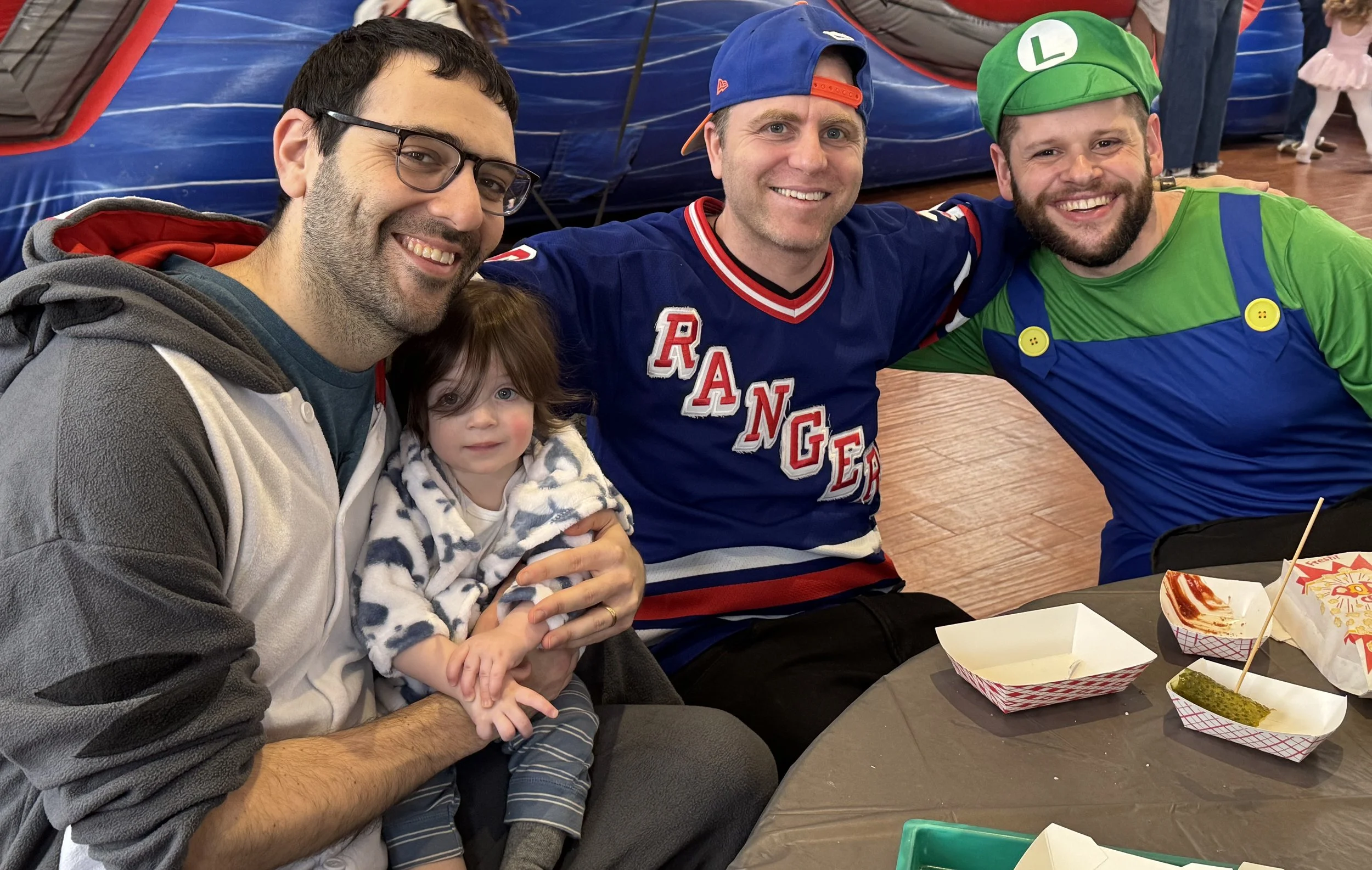
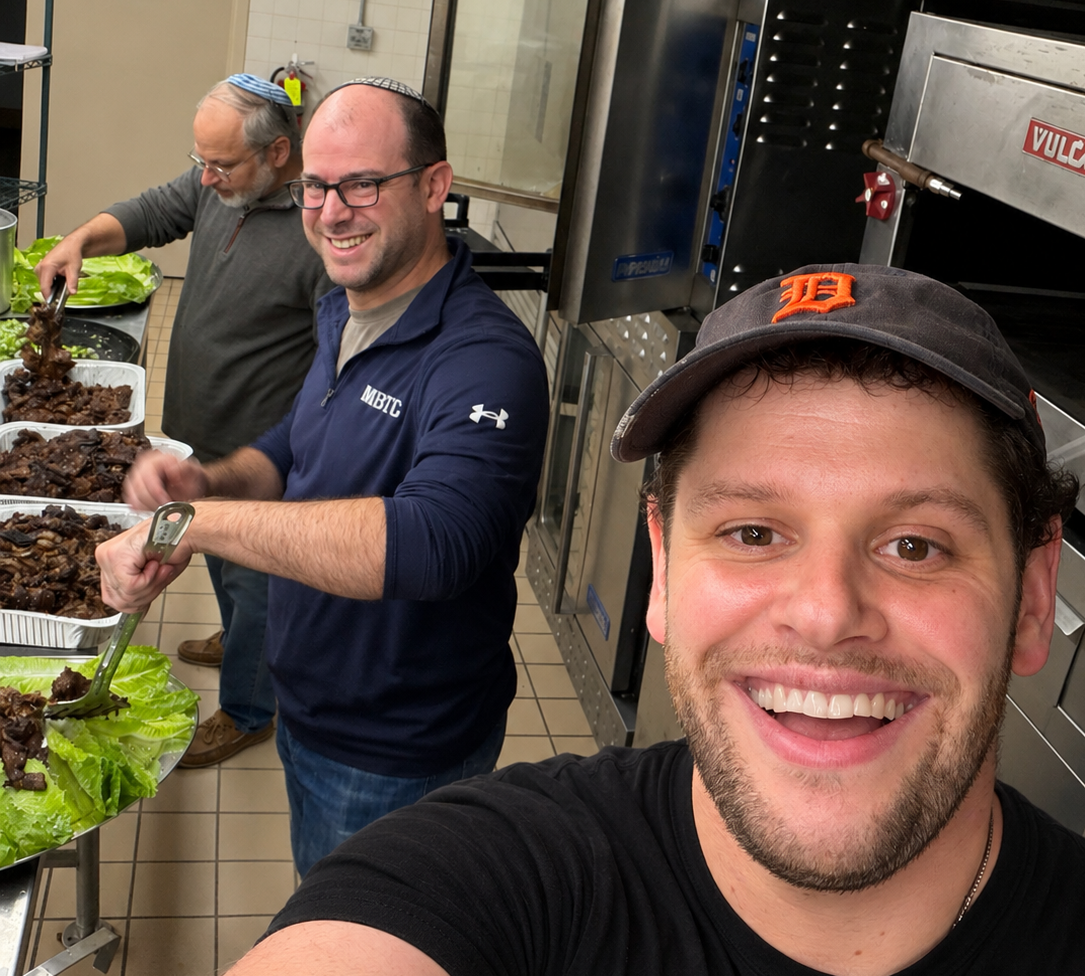
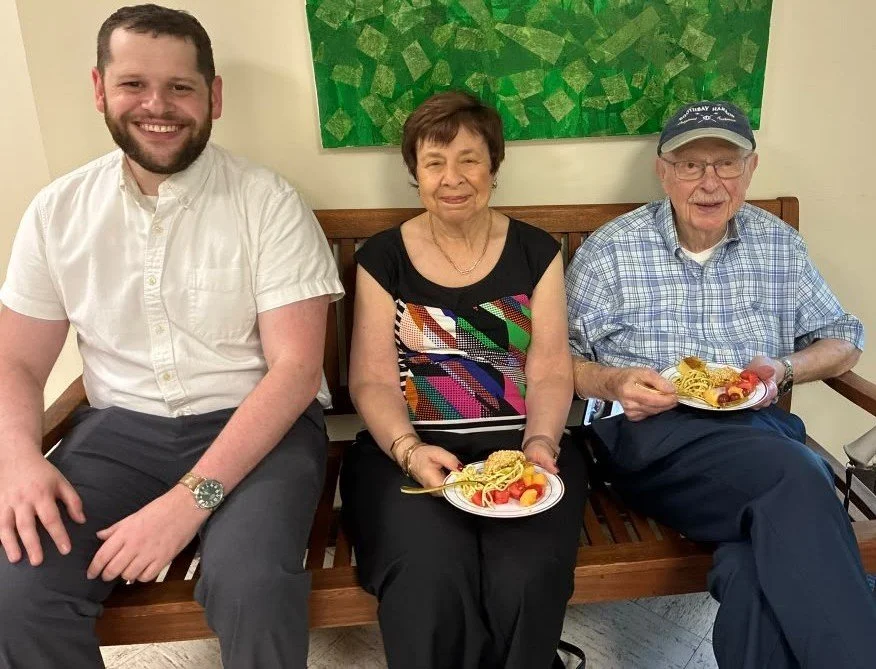
I view most shul programming as a chance to instill or reinforce the sense that shul is a place to be inspired. Shul is where we should find community and feel valued for who we are. That guided my revitalization of our men’s programming. I heard stories and saw the visual remnants of our then-dormant, formerly thriving Brotherhood chapter. I observed that older men in our community were finding other opportunities to connect, but there wasn’t anything connecting our younger men to the degree we wanted. Over time, I came up with the idea to start my “Kosher Dads Night” programming, where I take a popular, typically non-kosher cuisine and prepare my own kosher take on it. These events draw more than 30 attendees. The events are open to everyone from expectant dads to dads of 12th graders. I make the events free and actively recruit non-members and dads from our preschool to attend. The point is to welcome potential new members and to help men build relationships they might not otherwise form.
These efforts are successful because I approach them with thought and care. I truly love this work and believe it is what I am meant to do.
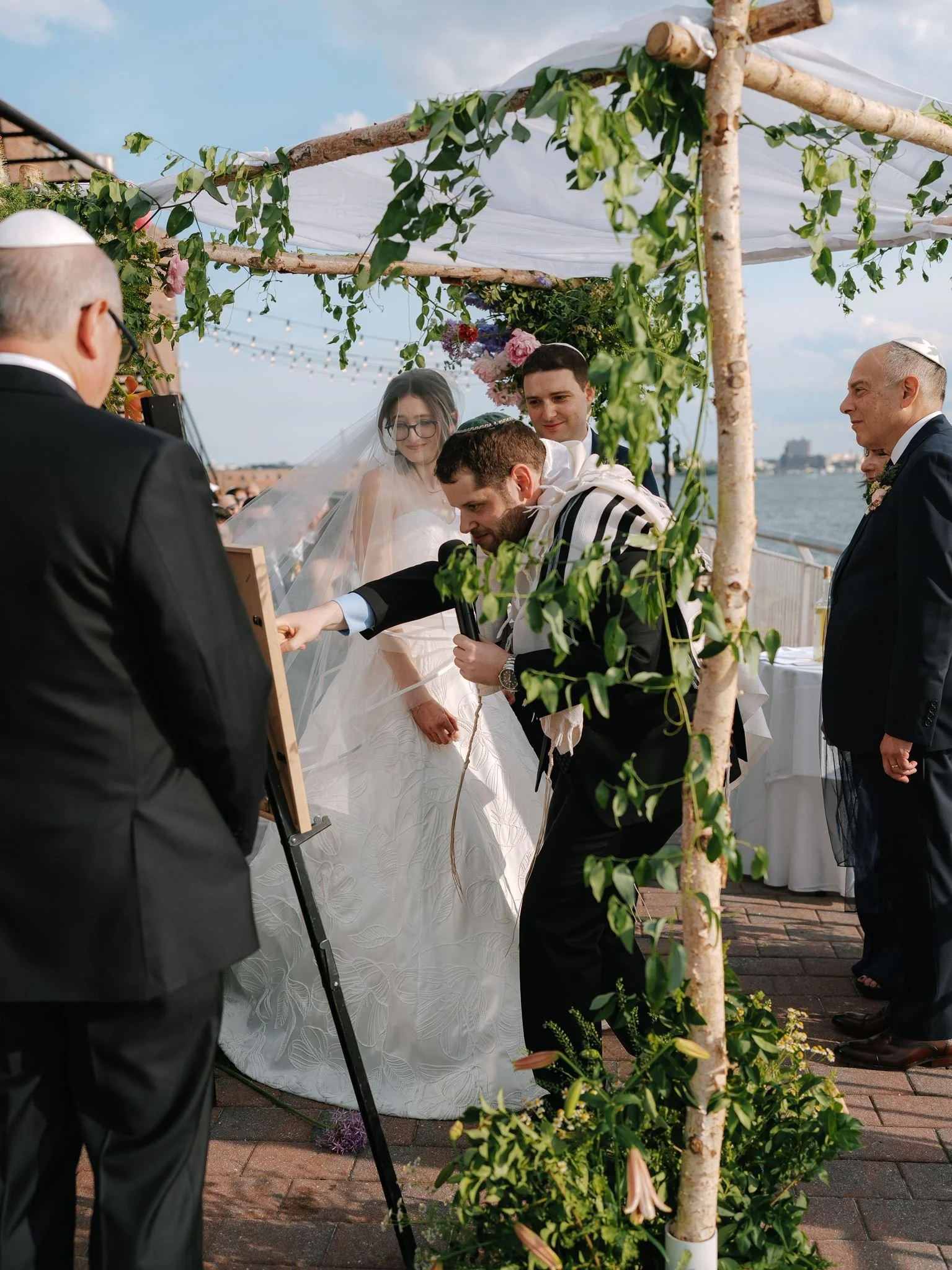
The rabbi’s role in life-cycle events is to provide structure for experiences that feel larger than life. These are the experiences of life’s beginning, life’s ending and the most significant moments in between. Judaism gives us frameworks for how to make sense of things in those moments through the rituals associated with weddings, funerals, b’nai mitzvah and more. It is my job to help guide people on how to best make use of these frameworks for themselves and their loved ones.
I do so by listening carefully and working creatively. I spend hours meeting with families, students and couples ahead of their event. I think deeply about who they are and how to best present their stories within the grand narrative sweep of Jewish peoplehood. All of that is informed by my love for the Jewish People and Judaism.
That same love inspires my community-building efforts. I’ve been most successful in this area with the revitalization of Temple Israel Center’s youth services and men’s programming. TIC’s youth services had never fully recovered from the pandemic lockdown. To change that, I worked with parents to identify and address key areas of need. Our youth service attendance is now often double or triple its former size as I continue to grow the ranks of our parent service leaders.
In my role at Temple Israel Center, I often write short articles that go out on Friday mornings. These are called “Erev Shabbat Thoughts.” Additionally, I write letters that accompany care packages sent by our synagogue to our college students ahead of some of the major Jewish holidays.
“An Erev Shabbat Thought - March 7th, 2025”
This Thursday evening will mark the beginning of Purim: a holiday of joy, giving and redemption. However, the general mood of our people is one of malaise. We watch as problems in our larger world and in our ancestral homeland seem hopelessly stuck. Yet Purim is there precisely to teach us that faith is the prerequisite to positive change. Deliverance comes from our looking to see how we as individuals can serve the highest good right in our own backyard, regardless of our circumstances. We learn that from Mordecai.
When Mordecai was a boy, he had a terrible accident that severely injured his hand. His parents feared that he would lose the fingers on the injured hand and raced him to the doctor. The doctor assured Mordecai and his parents that all would be well provided Mordecai allowed his hand to heal properly. A few weeks later, Mordecai and his sister were playing when Mordecai fell on the injured hand. Fearing their parents’ reaction, they rebandaged his hand and pretended nothing had happened. When Mordecai’s hand was unwrapped by the doctor, everyone was shocked by what they saw. His fingers were crooked. One of them was significantly shorter than the others. Mordecai was heartbroken. Looking at his hand, he thought to himself, “How will I play baseball?”
Mordecai—Mordecai Brown, that is—wasn’t done with baseball. He had faith that he could be a great player. He relearned how to throw with his new hand. He trained relentlessly and found his place as a third baseman on semi-pro and factory teams near his hometown of Nyesville, Indiana. His throwing hand’s unusual shape caused every ball he threw to move seemingly at random. Only he seemed to know where it was intended to land. Mordecai knew that wasn’t great for someone playing third base but suspected it could make him nigh unhittable as a pitcher. No one gave him a chance until one particular game when the starting pitcher was injured. Mordecai’s manager put him on the pitcher’s mound. One by one, batters stepped up to flail in vain before returning to their team’s dugout: the legend of Mordecai Brown was born. Mordecai went on to great success pitching for my favorite team, the Chicago Cubs. He helped guide them to their first two World Series victories in 1907 and 1908. These would be their only two championships for the next 108 years. Despite this, he was never the biggest name on these Cubs teams. He was a quiet but essential part of helping those around him achieve what they could not have alone.
More than two millennia earlier, a different Mordecai in the city of Shushan did something similar for his niece Esther. Mordecai was proud and brave—perhaps a little bit too proud and a little bit too brave. He would not bow before Haman. He was willing to risk the life and well-being of his niece. But he did these things for something greater. He did them because he believed the values of his faith were quite literally worth standing up for. He believed that Esther had a great role to play in saving herself and all of her people. Like Mordecai Brown, our Mordecai believed that a probable outcome was not a foregone conclusion. Incredible things are possible if we remain open to their possibility. Rebbe Baruch of Medzhybizh taught that in every generation we must see ourselves as if we, too, had been saved from Haman. This is because if one does not see the potential for miracles in their own time, then they haven’t fulfilled the mitzvah to truly hear the megillah read. God is not mentioned in Megillat Esther, yet we still speak of “the Miracle of Purim” because miracles require human beings to witness and realize their potential. We are not always called to be at their center. To make miracles happen, we have to pay attention to how we as individuals are called to help realize them.
The historically patriarchal bent of Rabbinic Judaism has tended to make Mordecai the star of the Purim show. I believe this is a mistake. We do not read “Megillat Mordecai” on Purim; we read Megillat Esther. Mordecai’s standing up to Haman was brave, but it was Esther’s cunning and bravery that saved the Jewish people. It is her act of redemption that is the reason for celebrating Purim. Still, no one achieves anything great without help from others. No one can achieve anything great without believing it is possible. To achieve something great, you do not need to be the most visible or celebrated part of that achievement. Mordecai Brown is far from the most famous member of those legendary Chicago Cubs squads. Mordecai of Shushan is not the namesake of our megillah. Yet without their contributions and their faith, tremendous achievements that mean so much to so many would not have been possible. My prayer for us all is that we may work together as a community and as a people to achieve that which at times may seem impossible. May our faith be a source of comfort and inspiration for us as it was for those before us.
Purim Sameach, Shabbat Shalom and, if I may, Go Cubs,
Rabbi Joshua Bender
“2026 Chanukah Care Package Letter to College Students”
Chanukah can be a challenging time to be a student living away from home. Sometimes it overlaps with winter break, but often it does not. When it doesn't, very often that means being away from home and family for the holiday. Finals are underway or fast approaching, as is winter break. It can just be too difficult to manage a visit home for Chanukah some years. You can light candles together over FaceTime with your family, you can go to events at Hillel, and all of that can feel very meaningful and special because where you are studying is a home. It just isn’t home. Home is where we grew up and where the people who know us best—childhood friends, parents and siblings—very often still are. We’ve hopefully grown to love our new home away from home, but celebrating Chanukah there is not the same. This doesn’t just present an emotional challenge; it presents a Jewish legal challenge as well.
The Talmud obligates us to light our Chanukah lights to commemorate the miracle of the Beit HaMikdash’s menorah burning for eight days on one day’s worth of oil. The Talmud specifies that these lights should be kindled in our homes. When we are being hosted for candle lighting, we are to cover a portion of the cost to the host. We are often hosted by others for Chanukah, even when we are living at our parents’ home. My family used to go up to my grandparents’ house for one night of Chanukah when I was growing up. That isn’t the same as having two different homes: one place where you live day to day, and another where you are from, and that you still return to. Being hosted by someone else is temporary. Even if the place isn’t your home, it still often has some of that warm, homey feel to it. Lighting candles alone or with a few floormates in your dorm or apartment has a totally different feel to it. That’s true emotionally, but it is also true legally.
Over the course of the Middle Ages and into modernity, Ashkenazim generally came to hold that students living away from home must light their own Chanukah candles. That’s because home is where these students are eating, sleeping and living day to day. Sephardim generally came to hold that students may rely on their parents’ lighting back home for them. Rabbi Ovadia Yosef explained that this is because where you live is still connected to your family home if your parents are supporting you there and, by extension, supporting your lighting candles there for Chanukah. That’s a financial justification, but there’s also an emotional one. Rabbi Eliezer Melamed explains that the family home continues to be your home if you return there with some regularity and it is where you go when you are sick. In other words, home stays home if we maintain our connection to it and it is somewhere we feel safe and loved. More than one place can feel like home, and those homes aren’t necessarily totally separate from one another. For my own practice, as someone who lives far from home and can’t be with my family for Chanukah, I prefer something of an emotional middle ground that falls within Ashkenazi norms. I try to always light candles with my parents, my brother and his family over FaceTime. We are each in our own homes, but we can still sing the same familiar tunes and open presents together from afar.
I hope that whatever your practice is in this regard, it helps you to feel connected to those you love back home as well as to the new communities you find yourself in for your studies. Please enjoy this care package, and may Chanukah fill your new homes with warmth, light and joy as it has filled our ancestors’ homes for generations.
Chanukah Sameach,
Rabbi Joshua Bender